Healthcare IT support: why reliable technology matters in modern healthcare

Healthcare organisations rely on technology more than ever before. From patient records and communication systems to cloud platforms and cyber security, modern healthcare depends on stable and secure IT infrastructure to operate effectively.
When systems fail, the impact reaches far beyond inconvenience. Downtime can interrupt services, delay access to important information and create serious operational challenges. That’s why healthcare IT support has become a critical part of maintaining continuity, security and compliance across the sector.
As finalists for Healthcare Technology of the Year at the National Technology Awards 2026 (winners announced next Thursday!), we’re extremely proud of the work we’ve delivered for healthcare organisations, including hospices. Here’s our approach.
What is healthcare IT support?
Healthcare IT support refers to the management, maintenance and protection of technology systems used by healthcare organisations and pharmaceutical businesses. This includes everything from day-to-day technical support through to cyber security, cloud infrastructure, disaster recovery and compliance management.
Unlike standard business IT support, healthcare environments face additional pressures due to the sensitive nature of data, strict regulatory requirements and the need for systems to remain available around the clock.
Reliable healthcare IT services help organisations:
- Maintain secure access to critical systems
- Reduce downtime and disruption
- Protect confidential patient and client data
- Support compliance requirements
- Improve operational efficiency
- Prepare for cyber threats and recovery scenarios
The growing importance of cyber security in healthcare
Healthcare organisations continue to be a target for cyber criminals due to the high value of sensitive data and the operational importance of healthcare systems.
A ransomware attack or data breach can have significant consequences, including service disruption, financial loss and reputational damage. For organisations handling confidential medical or pharmaceutical information, strong cyber security is no longer optional.
A proactive healthcare IT support strategy should include:
- Continuous monitoring
- Multi-layered cyber security protection
- Threat detection and prevention
- Secure backup solutions
- Regular system updates and patch management
- User awareness and security best practices
By taking a preventative approach, healthcare organisations can reduce risk while improving resilience against evolving cyber threats. That’s why we developed Threat Lens, our latest innovation in cyber security assessment, designed to give businesses a clear, complete and trustworthy view of their IT estate maturity. Built for organisations that need more than a traditional penetration test, Threat Lens brings every security vector together into one powerful, data-driven assessment.
Discover what Threat Lens can do for you
Why IT downtime in healthcare is a serious risk
Whilst having downtime is damaging to any business, in healthcare, system downtime can quickly affect productivity, communication and access to critical information – or, in more serious situations, negatively impact patient care. Whether caused by hardware failure, cyber incidents or human error, interruptions can impact both operational performance and service delivery. This is why disaster recovery and business continuity planning are essential components of healthcare IT support: healthcare organisations need confidence that their technology environment can remain operational even during unexpected events.
Healthcare organisations also face a unique combination of challenges:
- Legacy systems or unsupported platforms that limit scalability and security increase operational risk and limit future transformation.
- Availability and continuity risks are always present, especially in urgent and out-of-hours services where system downtime can directly impact patient safety.
- As risk of cyberattacks on healthcare organisations become more frequent, the impact extends beyond data loss into organisational governance. System breaches undermine public trust, interrupt services and place already-stretched organisations under scrutiny.
- Healthcare organisations are often reliant on small IT teams or key individuals, often creating reliance on third-party tools that offer limited visibility or control over data.
- Compliance obligations such as DSPT, Cyber Essentials Plus and HSCN connectivity place pressure on small teams.
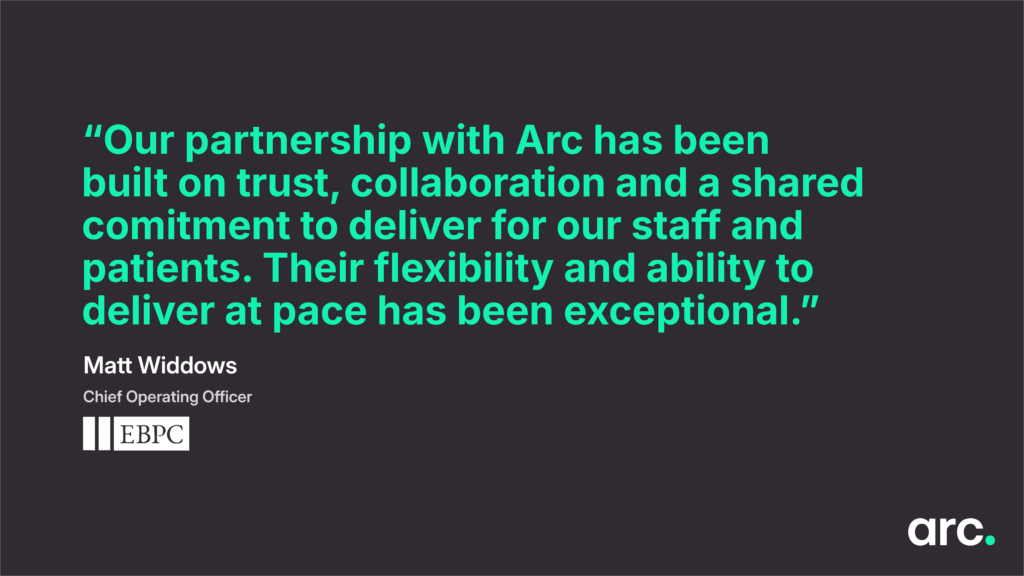
In urgent and out-of-hours care settings, Arc-supported organisations collectively serve populations of over 500,000 patients and, in these instances, even minor IT disruptions place severe pressure on clinicians and care delivery. Read more about how we support East Berkshire Primary Care (EBPC) here.
Compliance and data protection in healthcare
Healthcare providers and pharmaceutical companies must manage large volumes of confidential information while meeting strict compliance standards.
Data protection requirements continue to evolve, making it increasingly important for organisations to ensure systems remain secure, monitored and properly maintained.
Healthcare IT support can help businesses strengthen compliance by supporting:
- Secure data management
- Access controls and permissions
- Infrastructure monitoring
- Risk reduction strategies
- Information governance
- Secure cloud and hybrid environments
Working with experienced IT specialists can also help organisations align technology with wider operational and regulatory objectives.
Why work with us?
We’re not just an MSP, but a strategic technology partner. Our solutions are designed to stabilise healthcare organisations’ environments in a cost-effective way, while enabling growth and long-term transformation.
Our work supports many NHS providers, hospices and not-for-profit healthcare organisations, operating in highly regulated, high-pressure environments. We work as an extension of internal teams, combining managed services, cloud platforms, cybersecurity and strategic consultancy.
Our approach is simple: enable clinical and operational leaders to focus on patient care and long-term transformation, confident in the tech that supports them.
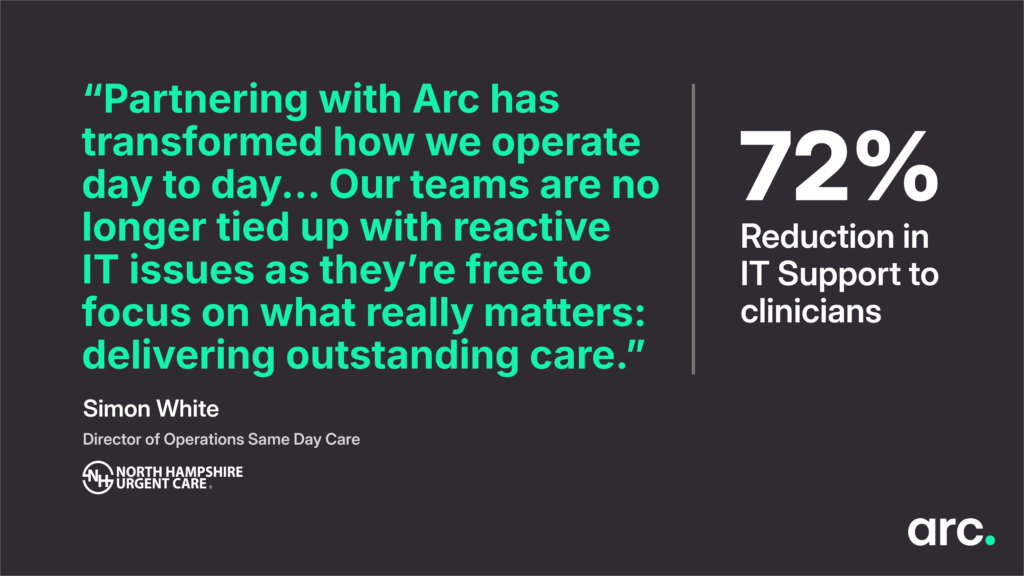
Our work has delivered sustained, measurable impact across clinical, operational and organisational outcomes. For example, by stabilising critical platforms and improving user experiences, we reduced IT support demand on North Hampshire Urgent Care’s clinicians by 72%, allowing frontline staff to focus on patient care rather than resolving technical issues.
Our cloud architectures have also enabled zero service interruption during major national outages, protecting urgent and out-of-hours services at times of high pressure.
The benefits of proactive managed IT support
Many healthcare organisations are moving away from reactive IT support models in favour of proactive managed services. Rather than waiting for issues to occur, proactive monitoring and maintenance help identify potential problems before they disrupt operations. This approach improves reliability, strengthens security and helps internal teams focus on delivering core services.
Managed healthcare IT support can provide:
- Faster issue resolution
- 24/7 monitoring and support
- Predictable IT costs
- Improved system performance
- Access to specialist expertise
- Scalable infrastructure for growth
For organisations with internal IT teams, co-managed support can also provide additional expertise and resource flexibility when needed.
As healthcare technology becomes increasingly complex, reliable IT support will remain essential for ensuring systems stay secure, compliant and available when they are needed most.
Final thoughts
Healthcare organisations operate in environments where reliability, security and continuity are critical. From protecting sensitive data to minimising downtime, healthcare IT support plays an essential role in keeping operations running smoothly.
By investing in proactive support, cyber security and resilient infrastructure, organisations can reduce risk, improve efficiency and create a stronger foundation for future growth.
For healthcare providers and pharmaceutical businesses alike, the right IT strategy is no longer simply a technical requirement, but a business-critical investment.

